News Story
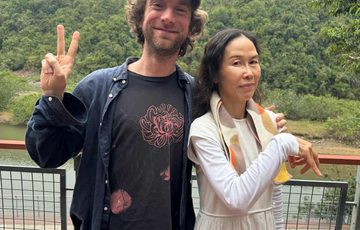
Hello everyone, my name is Dylan Read and I was very happy to have been chosen to take part in an international dance-theatre residency organised by Theatre du Pif in Hong Kong for the first 10 days of December 2025 as a collaborating member of Scottish Dance Theatre/Dundee Rep. I feel incredibly privileged to have been offered this opportunity to establish new connections with international artists, to expand my own practice and to act as a sort of arts-diplomat in representing both of these organisations overseas.
Below are some impressions and reflections gathered during my stay.
On the 1st of December I arrive into Sai Kung training camp, the location of our 10-day experimental theatre residency. I have just come off the back of a 17-hour journey which has taken me from Edinburgh airport to Hong Kong International, via Qatar. My feet feel big and puffy and my eyes are dry. I've been told that the weather is unexpectedly "mild" for this time of year (ie. roughly 26degrees Celsius every day for the entire duration of my stay), and that the humidity is apparently very low, even though the air feels quite thick to me. The taxi trip from Hong Kong airport to the Sai Kung peninsula passes through the dense city centre and across one of the many modern concrete bridges spanning Hong Kong harbour, which is buzzing with activity and industry. Massive cranes and muti-coloured stacks of shipping containers everywhere. The slices of city I catch from the taxi window are made up of thin high-rises, higgledy-piggledy commercial properties, spaghetti intersections and a surprising amount of parks and vegetation. As we leave the city behind, we eventually arrive to what is known locally as "the garden of Hong Kong", a huge territory covered in national parks and dense forests. The training camp (basically an outdoors activity centre for summer schools and adult team-building groups) is a blocky brutalist structure built on the shores of a bay, facing woodland and "uninhabited" islands.
To be honest I was not expecting such a secluded location for the work, and during the course of my time there I come to understand that even for locals it is seen as a real privilege to be able to access a week and a half of creative exploration in such a calm spot, away from the hustle, bustle and responsibilities of the city.
My flight arrived in slightly later than expected so I've missed the morning introductory session which apparently consisted of going down to the river and writing a haiku inspired by the flowing water. The task I join in with is a continuation of this, and involves choreographing and performing a "movement haiku" which captures something of the essence of the river, or at least communicates something of a fleeting impression. I spot the first of many jumping silver fish, and am so taken by it that I decide to focus on conveying the impression of this silver flash.
There are in fact many wild animals I spot or encounter during the course of my stay in Sai Kung. On the wooded banks facing our training camp we can spy the occasional wild pig/hairy boar, as well as graceful white storks and kingfishers gliding down over the water, and various kinds of delicate kaleidoscopic butterfly. These are our wild and free companions during the workshop, serving as a counterpoint to the cramped tanks full of sad crabs and eels ready to dice up and eat outside the local fish restaurants. There are also mosquitos and fiery biting ants, both of which quite enjoy my exotic blood apparently :)
For the first few days I am still jetlagged and adjusting to the timetable, and the combination of humidity and mosquitos leads to quite sleepless nights. However, being quite spaced-out and in an entirely new context can prove to be quite useful for exploring new imaginative spaces, and I try to use this discombobulation as an opportunity for breaking my existing, habitual forms of thinking and working. I'm feeling a little tender, so I try to lean into it and soften in my approach to movement (more suggestion and subtlety than dynamic attack) tasks (ie. not trying to lead with a "do it right" attitude) and to communication (prioritizing listening and taking a moment to think/feel rather than rushing into speaking).
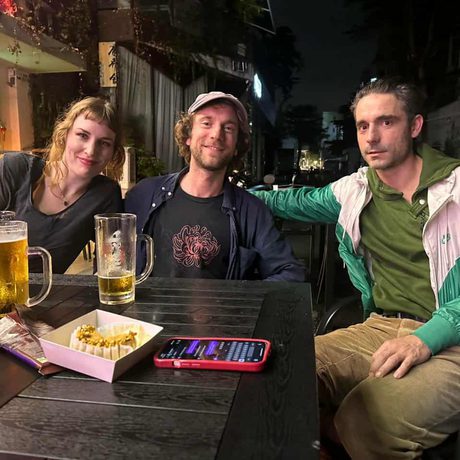
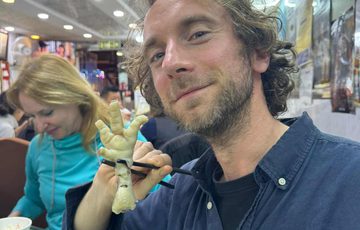
Food-wise, my new discoveries were chicken's feet (gelatinous), hot Coca-Cola and ginger (apparently good for the flu, which I didn't have), barbequed white bread with honey (simple, tasty), lots of midnight instant noodles, and incredible coffee. It would appear that coffee is a massive thing in Hong Kong, and lots of the participants had very strong opinions about the best pour-over, batch brew etc. I don't mind instant (especially the new frothy one) but didn't mention that. We also go out on a couple of evenings to a nearby town and drink delicious lager at the end of a pier like teenagers, much to the amusement of the local fishermen.
Image gallery

I won't go into huge detail about the content of each day, but suffice to say that Bonni Chan and Theatre du Pif managed to tailor + curate a sequence of workshops through the 10 days that felt like a genuine journey, with each session building upon fundamentals which had been established the previous day.
The workshops generally consist of a mix of five main ingredients:
1) Feldenkrais awareness-through-movement
2) image-led Butoh scores
3) construction of visual/theatrical tableaux and transposition of written text (poetry/dialogue)
4) playful body-in-space sensitization
5) site-specific research and performance
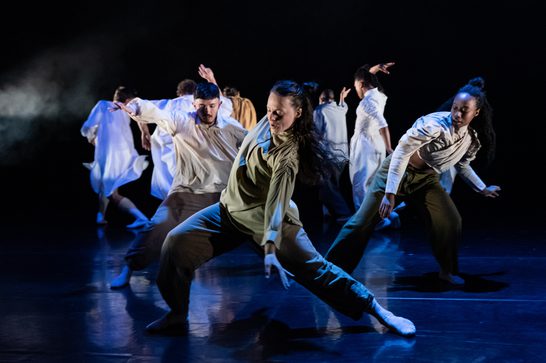
And all of this was topped off with incredibly subtle, playful and discerning feedback from Bonni Chan, who would end (and sometimes begin) sessions with a circle in which we could feedback our thoughts, dreams, remarks, observations and questions. Her responses would always be tailored to each individual, whilst containing philosophical provocations and concrete examples relating to the nuances of our shared craft as theatre-makers. The 5 "ingredients" listed above may all have their own distinct flavours, but they were brought together into one unified dish by our head chef Bonni, whose pedagogical approach continually emphasised the parallels and poetics of how each session related to the last. I definitely got a sense of how Theatre du Pif (the performance company which Bonni runs with her partner Sean Curran) is a "total" theatre which pulls from various influences across arts, life and politics with the aim of creating genuinely playful and transformative work. All done with great humour, humility and integrity!
1) Feldenkrais and awareness-through-movement
I had encountered Feldenkrais over a decade ago whilst training at the Lecoq school in Paris. Jos Houben, my teacher at the time, was a Feldenkrais practitioner and would lead sessions bi-weekly. Essentially this is a movement philosophy developed by Moshe Feldenkrais that encourages subtle research into ease, release, and the principles of physical mobilisation which, as well as allowing for simple and healthy use of one's body, all have fundamental emotional, social and spiritual resonances for the individual's sense of self and their connection to the outside world.
Often starting with participants lying on their backs and noticing minute shifts within their bodies as they breathe or action very small movements, each individual is to take the prompts at their own pace, and is really encouraged not to jump straight to an imagined or "ideal" outcome, but rather to notice the detail of the journey itself. Transition, rather than completion, becomes the focus, and we become attuned to the gradual shifts and engagement necessary for an idea, intention or image of movement to come to fruition. Where are the unnecessary efforts? What tension is blocking and can be released in order to allow for greater ease, joy and fullness?
Inevitably, many of these practical bodywork exercises become very concrete metaphors for the ways in which we work. How do we use our own bodies (and those of others) as "tools" to convey our ideas? What aspects of "control" could be released? How tightly do we hold onto an idea? How clearly do we see the world around us, and how honest are we about what the situation-at-hand really is? How can we keep things fresh and vital whilst prioritising curiosity and pleasure and avoiding an oversaturation of energy?
"The Feldenkrais Methos is not to nurture flexible human bodies, but flexible human minds. I want to restore the dignity of a human being" (Moshe Feldenkrais)
2) Image-led Butoh scores
Butoh is a contemporary dance-theatre practice which originated in Japan after World War II and in response to the horrors of Hiroshima and Nagasaki. Butoh can be danced solo or as a group, and has spawned/mutated into different approaches and variants depending on which school or practitioner you follow. In my understanding, and to be very simplistic about it, one stem follows Tatsumi Hijikata's more grotesque, earthy-shadowy approach, whilst the other is inspired by the delicate softness of Kazuo Ohno. Both involve transformation of the body and spirit via a kind of total commitment to imagery held in the mind's eye. Dynamics such as a moth struggling under wet mud, becoming a thin vertical line in an endless desert, or walking into a cherry orchard and gradually dissolving until one becomes as light as pollen blown on the wind.
Personally, I have found this type of work to be a great continuation of the more non-naturalistic research I encountered at Lecoq, and a very useful bridging tool between "dance and "theatre" (as they are separated in our culture). Non-verbally, so much is communicated, and even if the audience are unaware of the guiding image behind the improvisation they are still hit by waves of emotive imagery as the performer's body and the space around it is transformed. As with Feldenkrais, Butoh requires a continual sensitivity to the present moment. In the rigorous balance between being "carried by the image" and concentrating on the purely technical aspects (maintaining balance, staying "open" under the audience's gaze etc) a kind of moment-by-moment flow state can be reached which, rather than being pure trance (from which the performer cannot easily snap-out) is rather a sharp and embodied mindfulness. Butoh is also interesting in the ways that it can expand expressive possibilities for the individual performer, digging into spaces of "shadow", and extremes of pleasure or disgust within their psyche, it can help to open up new spaces of emotive/dynamic possibility which exist beyond traditional technical form, and at the fringes of our sense of self.
3) Construction of visual/theatrical tableaux and transposition of written text (poetry/dialogue)
Here a recurring task throughout the 10-day workshop was to take inspiration from pre-existing text and imagery (in this case, traditional Japanese woodblock paintings) in order to create our own static and/or dynamic tableaux. A line of text or a detail from a picture could provide the stimulus for a fixed solo or group image, which the rest of the class would observe and feedback on. This becomes a training in interpretation (what details do you choose to focus on? What does that communicate? How do you transpose them into an onstage image? What does that communicate?) and also, for the audience, a training in "seeing" work which is in-process. We are asked to suggest small or larger tweaks to the image: how does each tweak affect our reading of the situation or the emotional impact of the picture? First, we begin with a solo transposition of a shard of poetry, then we move onto a group interpretation of details within a painted image. We are asked to create 3 tableaux (before, during/present moment, and after). How can we transition from one tableau to another? How does the quality of each transition inform our reading of each composed image? What is the flow of the whole? How can we think of our choreographing of visual theatre as a type of writing, in which ideas and emotions flow and develop in great tides channelled and catalysed by verbs, nouns, punctuation etc. What if "transition" was the main thing? Perpetual mutation with certain accented moments (sliding fixed points) which, when arranged with a compelling/surprising rhythm, allow us to see the whole.
We work on texts we have brought in and learned off by heart (in my case, Yeats' "The Second Coming") alongside poetry by Mary Oliver, dialogue by Sarah Kane, Hokusai woodblock imagery, and paintings of the Japanese ghosts known as Yokai. We are also continually encouraged to draw, read and write as a continuation of our stage craft. How do all of these expressive forms speak to one another? What can be learned from each of them? I feel very honoured to be in the company of visual artists, writers, directors, choreographers, photographers and scenographer/costume designers as well as dancers and actors. Our discussions around the interrelation of these forms proves to be joyous and enlightening!
4) Body-in-space sensitization/exploration
These exercises and games (mainly games, for even the more "dry" or technical exercises were introduced and led with the spirit of play) are means to encounter the performance space and our own body-in-motion without judging, deciding, or analysing beforehand. We are to throw ourselves into pure, vivifying experience and feel the resonance/reflect on them afterwards. Perhaps this space of reflection is with the rest of the group, or it might be something jotted down privately in a notebook. We are also encouraged to sit with our thoughts and feelings, allow our reactions to these exercises to exist and pass without dwelling too much on them. We might go and sit by the river, or lie on the ground, or have a cup of coffee, and allow what we have just encountered to percolate within our body-mind.
We play Grandmothers' Footsteps, we run through the space with our arms spread wide open, we fall backwards into another's arms, we maintain palm-to-palm contact as we lead our partner on an eyes-closed journey through the space, we try crossings with even rates of acceleration or deceleration, we dance in circles and try to pull each other off balance.
Some discussion/reflection points brought up by these kinds of explorations:
- Can you allow yourself to trust your partners? What can you learn from them? Can you trust the space? What does it reveal to you? Can you trust your own body? What does it already know which your conscious mind may not have even realised yet?
- How clear can you be about your role? Are you leading or following, falling or catching? How can you commit totally to this role? What do you learn from this total commitment?
- Are you a sun-actor or a moon-actor? Do you "go out" to the audience with your energy, or do you draw them in?
- Do you follow the initiating impulse of your action all the way to its conclusion? Can you commit to completing your action?
- The human being is a bridge between the sky above and the ground below. How can we situate ourselves at this unifying point?
- Send your awareness down from your head into your core and down through your legs. Send the little postman to deliver his Christmas cards to all different parts of the body.
- Sensitivity grows, perception changes, expression changes.
5) Site-specific research and performance
I could say that all of the above points are leading us towards this fifth and final key element of our workshop, but in actual fact there is no hierarchy or prioritization of research during our time at Sai Kung training camp, and Bonni has been very conscious and careful to de-emphasise any results-based approaches in her teaching. We are here to take each provocation, game and exercise on its own terms, and to enjoy each moment as it comes.
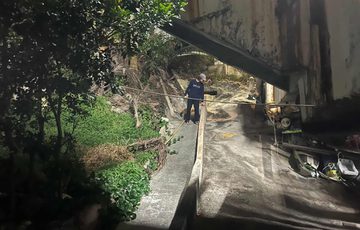
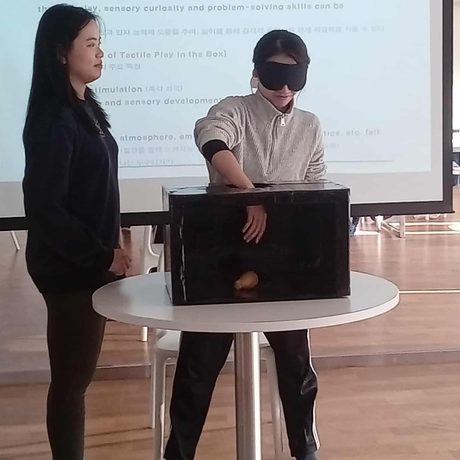
Having said that, site-specific performance research takes up a large chunk of our time, especially towards the latter half of the workshop. Around day 5 we are joined by South Korean stage designer Lee Yun Soo. Yun Soo is a regular collaborator with Theatre du Pif, having worked for them for over 15 years, and is widely regarded as a master of his craft. Through a mix of power point presentation (with simultaneous English and Chinese translation), multi-sensory games, site visits and creative provocation, Yun Soo invites us to consider the ways in which performance can be created for, and in dialogue with, a specific non-theatrical space. In this case the Sai Kung camp itself.
Image gallery
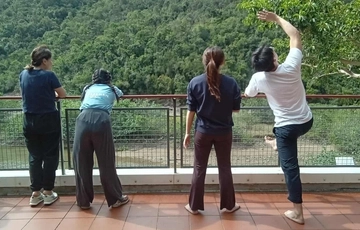
At all times we are encouraged to return to our senses. Over and above any concepts we might have relating to the site or our desired performance, how do the concrete, tangible elements of the site impress themselves upon our senses? What can we hear, feel, taste, smell, see? What are the emotional resonances of spaces? What images or memories are brought to mind when we really take time to fully encounter the sensory dimensions of a site? Personal and poetic associations, unexpected connections, distant nostalgic memories rise to the surface. What stories come to mind that are born of these sense impressions? How does energy flow through these built environments? What is their traditional use, and how can this use be subverted? What are the pools and eddies within a space where some half-forgotten stories or characters might linger? How does the whole site transform as the sun begins to set and we transition into night-time? What constitutes an atmosphere, and how can this raw material be used within our storytelling? Where does the Genius Loci (or spirit of place) reside?
In the studio we play more games, this time to train our various senses:
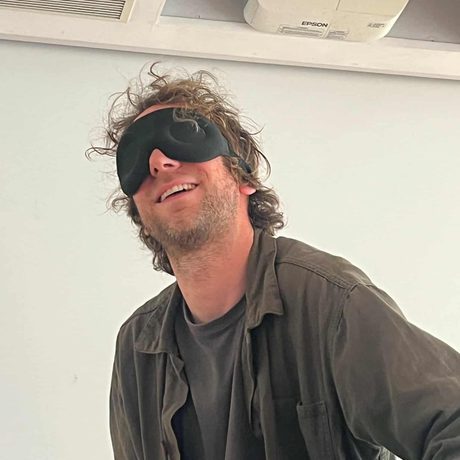
Blindfolded, we sit at a table and reach into a mysterious box. Inside is an object/material seen by the audience but unknown to us. We discover this object with (and through) our touch. Once we've had this encounter the object in the box is taken away and we remove our blindfold. Instead of trying to guess what the object is (ie. trying to "grasp" and categorize it cerebrally by "naming" it), we instead recount what our experience of reaching and exploring was. What images, memories, emotions came to mind?
We do a similar thing but with taste. Again, sitting blindfolded at a table only this time we are given a piece of bread with a strange unknown substance on it (vinegar, honey, chilli oil etc). Again, we don't try to name the food, but instead speak of our sensory experience and its associations. Taste is so intimate and personal, and people are inevitably brought back to very specific memories from childhood (in my case, eating fish and chips after a long cycle ride on the Isle of Skye).
We also play guess the sound with strange objects, explore touch textures, and draw ground plans of imagined fantastical "homes" to engage our proprioception and emotional connection with space.
Armed with all of this, we are then tasked to create a site-specific, promenade performance for an audience of workshop participants and invited guests which be shared on the final day. The Sai Kung camp is large, so we have plenty of spots to choose from. We have to choose one location (or route between several locations) and create a story/journey within that space which will immerse the audience into a mix of site-reality and performance-fantasy in some way. To start us off we are divided into 3 devising groups, and each group has to choose from a jumble of key words offered by Yun Soo. We choose our words (in my group's case: "Zoo", "Dream" and "Revenge") and wander the site searching for a spot or two which might catch our attention or chime with our intuition. During the course of the week, we can revisit these spaces as much as we like: we do so in the early morning, between workshop sessions, and late at night to experience the full palette of possible atmospheres. Slowly, characters, text and stories begin to emerge. Some silent images, some repeated gestures and muttered songs, we become curators of a 4-dimensional concrete poem: a kind of installation which the audience are guided through whilst being free to explore as they wish. A question: how do you frame the audience's perspective? How much freedom are they afforded? Can you coax them into making a particular association within their own minds, or is part of the pleasure allowing for a complete freedom and variety of interpretation?
Our performance ends up being a kind of "ghost train" passing through the lowest level of the camp. It begins at sunset, with the audience facing out across the lapping waves of the bay, from this point they are led away into the heart of a concrete labyrinth, finally ending up with a strange looping path that turns in on itself and goes round and round, chasing its own tail like a kind of perpetual purgatory. Along this path are several entities who stand by running water or leaking taps, singing quiet songs or shouting across long distances to partners fading into a mist. It's proper spooky.
Our final day at Sai Kung is a half-session of reflection, thank yous and goodbyes. Everyone is setting off back to their busy lives of studies, production, filming, making, house care, family and friends. We all exchange contact details and laugh about the wee daft things that happened during the week, but you also get the feeling that real grounded connections have been made, and everyone seems quite humbled by the experienced, more relaxed and more "decided"/in themselves than they had been at the start of the 10 days. I have that funny feeling of saying "goodbye" like a "see you later", even though I'm aware I'll soon be travelling back to the other side of the world.
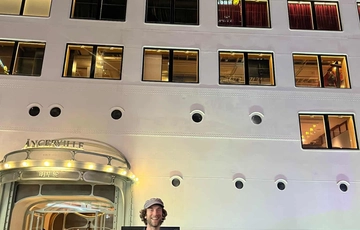
On my day off before catching the first of two flights back home to Scotland I cross the border to mainland China. I do not have a visa, so this crossing is only possible for me due to my French passport (British passports are not accepted for tourist visits without a complicated and expensive visa process). The nearest city is Shenzhen, where some friends of mine are performing an immersive dance-theatre show by Gecko Theatre's sister company Dream Awake. The show is called "The Deal", and is based on an earlier Gecko show called "The Overcoat" (itself a retelling of Nikolai Gogol's short story about a Faustian pact between a poor clerk and a Mephistophelian tailor who trades him a luxurious overcoat for the price of his soul). It features a rolling cast of about 15 people, all highly skilled international performers, and takes place inside a former luxury cruise ship which is now permanently docked in Shenzhen's historic harbour. Several floors of the ship's interior have now been converted into elaborate sets, which the audience are free to explore, observing (and occasionally participating in) the performance which is happening all around them before being guided down to the next floor and the next scene. My friends Briony and Adam are on long-term contracts and have helped in the devising of the show, alongside my new friend Chu who was one of the workshop members back in Sai Kung!
It's a pleasure to see this world-class visual theatre show, and I feel so lucky to have been given the opportunity to attend a workshop right next to where my good friends are performing. Still buoyed by the new friends and discoveries made in Sai Kung, and now buzzing from seeing old friends performing large-scale immersive theatre, I get on a ferry back across the bay to Hong Kong International airport and prepare myself for the long-haul back home :)
Many thanks to Scottish Dance Theatre and Dundee Rep for putting me forward to participate in this experience, thanks to Bonni, Sean, Yun Soo and all the administrative team at Theatre du Pif for hosting me and leading this fantastic workshop, and thanks to all the friends I met along the way. I sincerely wish our paths cross again soon. I'm hoping these experiences will inform my work and collaborations within my own Scottish context, and that I will find opportunities to share some of these discoveries with the performing arts scene here.
Cheers for reading!
Dylan