News Story
The beginning of October 2025 brought a unique experience for the company. We travelled to Poland for an intense and beautiful experience of artistic and philosophical exchange and really, really good food. We were there to participate in a collaborative project called ‘Museum Of Futures’, between Ciało/Umysł Foundation led by director and dramaturg, Agnieszka Jakimiak and us, Scottish Dance Theatre, led by Artistic Director, Joan Clevillé. Located in the idyllic location of Studio Burdag, an immersive residency space in the Mazury region. The project brought together six independent dance artists from Poland; Stanisław Bulder, Magdalena Kowala, Aleksandra Lemba, Daniel Leżon, Sos K. Osowska and Misia Żurek and six dance artists from Scottish Dance Theatre; Kieran Brown, Molly Danter, Ben McEwen, Kassichana Okene-Jameson, Massimo Monticelli, Pauline Torzuoli.
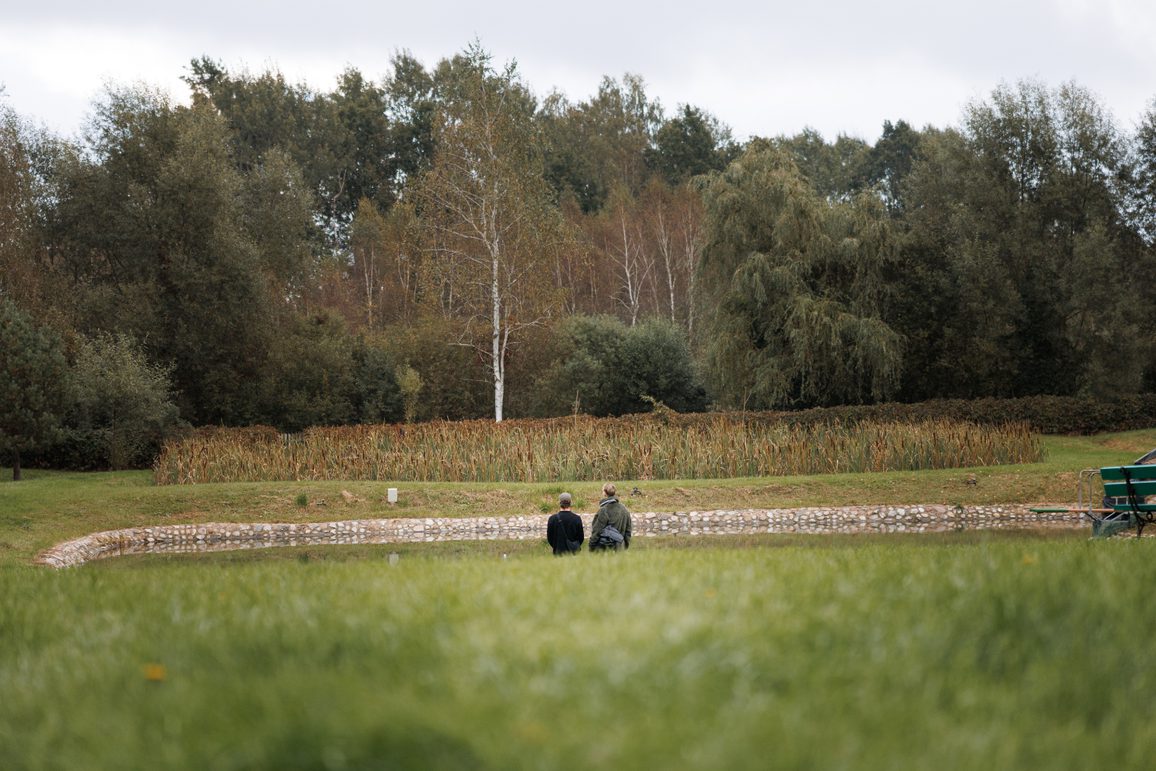
Journeying from Edinburgh to Gdansk our sense of welcome was immediate, being met by a friendly, gentle musician named Pawel who was working for the festival to drive us to the residency. Except for a brief relief break at a service station where Joan tried some mashed potato flavoured crisps (they really did taste like mashed potato!) we drove the two and a half hour way to Studio Burdag. After a sleepy feeling from the long motorway journey, our curiosity was energised as we rumbled up the single track road, being waved onwards by branches of birch and pine. Surrounded by trees, the space hosted four buildings, two of which were for our use during the residency; The Barn and The Cowshed. Upon arrival we were welcomed into The Cowshed where most of us would be sleeping, and where a delicious and wholesome lunch was already waiting for us, giving us our first taste of what we were in for during the rest of our time there. We had a welcome couple of hours to settle into our rooms and independently explore what would be our home for the next six days. I think we each felt the wash of calm that being surrounded by the peaceful green of forest and grass brings. With ponds, vegetable patches, fruit bushes and the enticing invitation of hammocks softly rocking in the rippling breeze, there was a sense of nurture, space and creativity. That evening the Polish artists arrived and we shared a meal together, noisy with the excitement of new connection and the fairly regular exclamation of how good the food was.
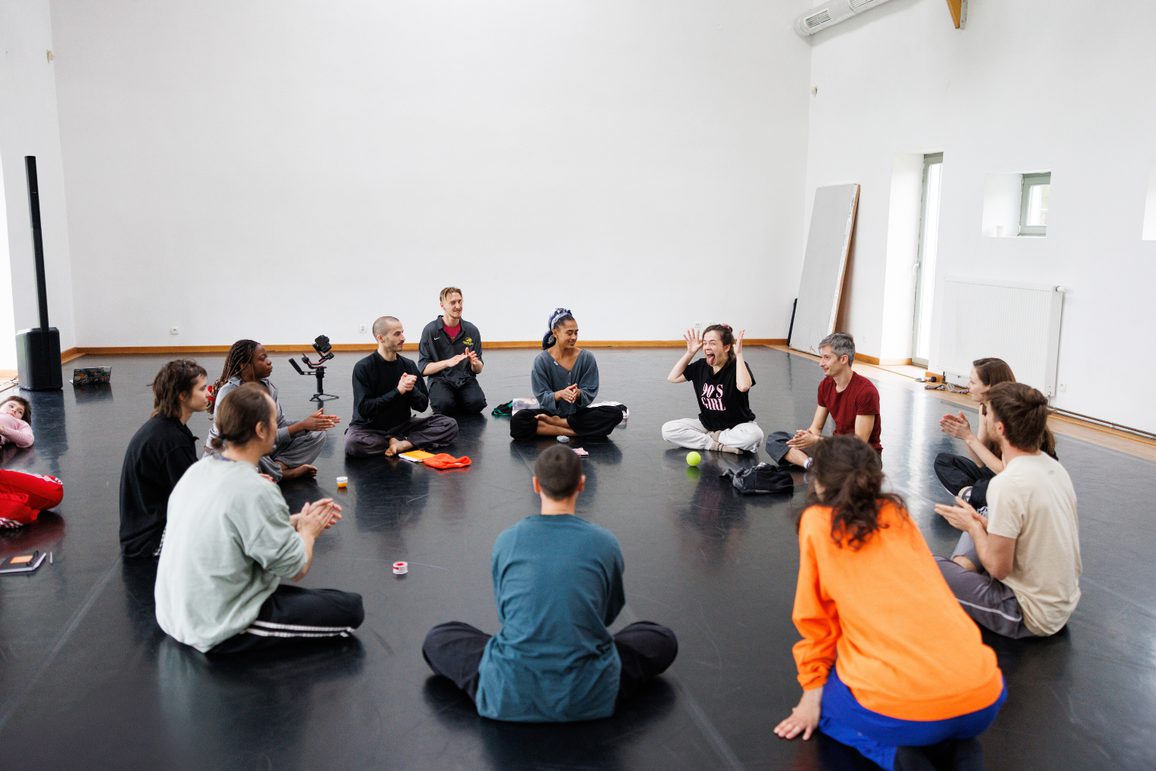
The lense of the residency was Museum Of Futures. Our brief was that “this will be a unique opportunity to share, explore and experiment with dance, choreography and dramaturgy as tools for imagining futures that are not defined by technological progress, but by empathy, care and relations. Together we will explore what the “body or bodies of the future” could mean: imperfect, empathetic, and communal.” Joan and Agnieska were curious about collective ways of working and decision making. The ideas and practices responding to this brief were to come from any and all of us, out of our diverse experiences and interests. We could propose something at any point, choose to follow another person’s propositions, change our mind, try something else, work alone. A dedication to process was a priority of the week, at times coming into a natural tension with the awareness that this residency was leading towards a sharing with the public in the Museum Of Modern Art in Warsaw. Rather than a productivity, we were cultivating a ‘processivity’, which feels unfamiliar in our capitalist times. The event at the museum was to be a sharing of practice, more than a choreographed performance. It was an experiment that felt brave and vulnerable: would it be interesting for the public to witness how we work rather than seeing a polished and rehearsed product that they are used to?
‘The future’ is an intimidating subject in its vastness when trying to imagine practices to lead us there, or to bring the ‘there’ to ‘here’. There is a sense of responsibility: what do we want to do and undo to create a future we believe in? There is also an optimism, room for play in imagining infinite possibilities. Aided by a document of prompts preprepared by Agnieska and Joan, propositions of practices trickled in and clear themes emerged; play, healing and empathy, connection with nature, embodied intelligence, social justice, storytelling, slowness.
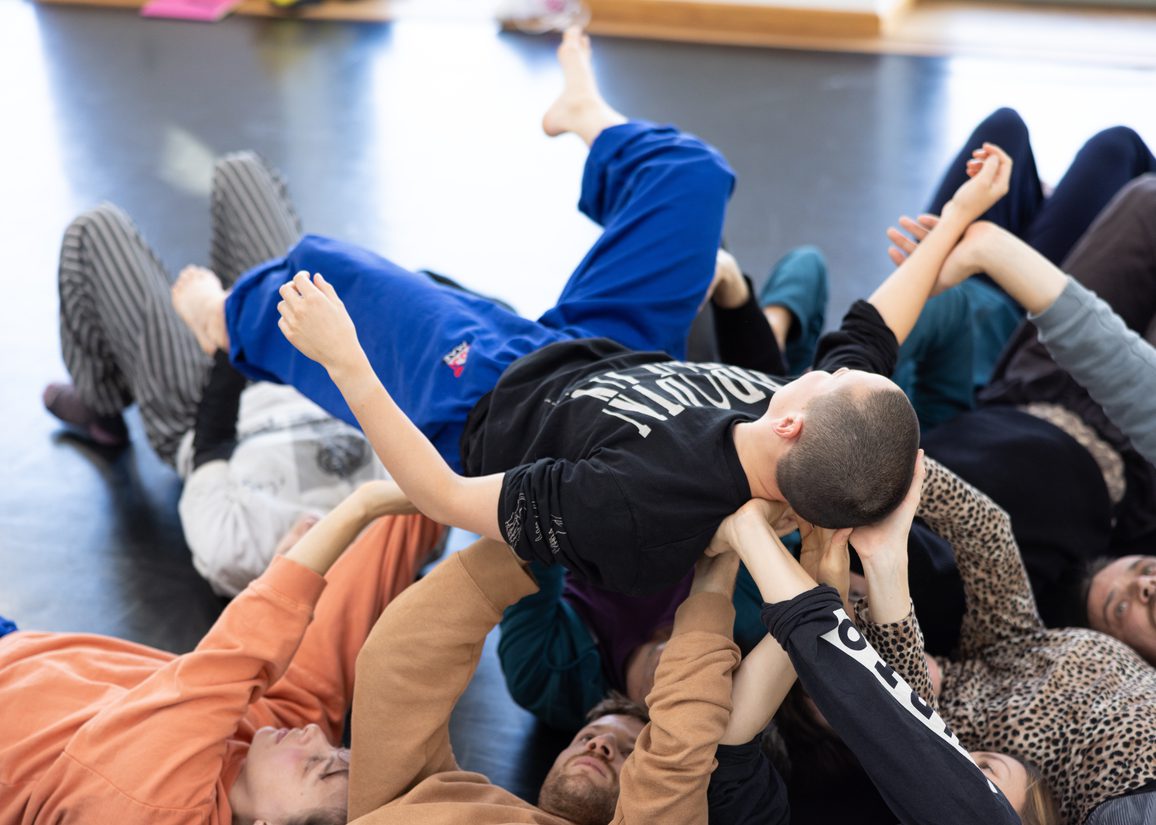
To describe in detail all that we explored would take too long, however here is a non extensive list of practices that arose during the week; an attempt to rewild the inner child, a practice of intimacy and consent, a score of solidarity, a forest of arms, tantric breathing, a lecture on the history, politics and philosophy of museums, a rave, tuning into felt sense, dance as prayer, undoing and learning to hug, a guest book for past and future guests, a collective poem, a ceilidh and a murder game that has continued beyond the residency (it’s now down to a duel between Joan and me).
On the final night of our time at Studio Burdag we put on a ceilidh, a night of Scottish traditional dance. Sadly I got a migraine just before we were to begin and had to abandon my ‘ceilidh calling’ duties (explaining and demonstrating the dances). Thankfully we had Ali (Alastair More), who was there to film and photograph the residency, ready to step in. Even from my migraine delirium in the other building, I could hear sounds of true ceilidh spirit ringing through the evening air.
It was finally time to leave and quite a change from the peace of Burdag, we found ourselves in the heart of Warsaw. After the intensity of working, eating and sleeping together for the previous week in the company of nature, it took a moment to readjust to the very different intensity of the hotel and city atmosphere. We had a day off to explore the city and in the evening a guided tour had been arranged for those who wanted it.
Finally it was time to go to the Museum of Modern Art, from the outside a large white cuboid and inside, spacious and dazingly white with windows on every side. We were informed that the building held some controversy, with some of the public loving it and some hating it. The Museum of Futures event was to use mainly two places in the museum for our sharing: a high-ceilinged room with curtained entrance from two corners and a performance space on a depressed laminate floor with room to view on four sides and which looked all the way up to the roof, allowing those on the floor above to look over a balcony and down on us.
The first space hosted an installation space entitled ‘In Place Of Absense’, initiated by Kassi and me to hold space for making visible “what bodies haven’t made it here and the loss we will have if they do not make it to the future.” The space was empty except for a guest book for past and future guests that anyone could add to, and a movement score that held an invitation to dance in the space with the unseen bodies of past and future. The space was held by the sound of ‘Love Frequency’ by a choir called Celestial Being. This space felt poignant and hopeful at the same time, at one point it was full of people dancing, earnest and uninhibited.
In the other space we moved through different practices we had explored during the residency. Including; Stanisław leading us and any willing public through a rave, Kieran sharing a practice called Focussing, Misia disappearing into the crowd to play with a hide and seek score, ‘rewilding her inner child’, and altogether performing the Solidarity Score, initiated by Joan, on this occasion choosing to be in solidarity with those fighting for reproductive rights.
The event of Museum of Futures felt special. With all our questioning, I think the experiment worked, the audience seeming to be curious and moved by this unfamiliar form of performance. One member came to me afterwards to share their emotion at what they had witnessed. Endings are always a strange feeling and luckily ours was supported by a meal and drinks provided by the museum, allowing us to relax and digest the event and the week in good company.
This wasn’t the end for the company as we were also performing Ray by Meytal Blenaru in the Stanisław Ignacy Witkiewicz Studio Theatre at the Palace of Culture and Science, nearby the Museum of Modern Art. The show was beautifully received, helped I’m sure by Massimo’s warm welcomes using the pieces of Polish he had picked up. The audience were so engaged, and I was thankful for the post-show discussion that allowed us to hear their responses. The talk was hosted by a previous SDT dancer, Artur Grabarczyk, bringing an extra feeling of familiarity and welcome.
It wouldn’t be the end until we had one more meal together, this time at Cafe Kulturalna, who had been providing our meals throughout our Warsaw stay. At some point someone requested that we do a ceilidh dance and so I asked the staff if that would be possible. They gave me a strange look and said that they supposed it would be ok if it was only one. And so, I led everyone in an Orcadian Strip The Willow down the length of the restaurant. The infectious joy of the ceilidh swept up a few others eating in the restaurant who weren’t a part of our group and even a staff member! Classically, it didn’t end there and with the blessing of the staff we did another one, followed by a Polish traditional dance led by Daniel. It was the perfect energetic and symbolic end to our time in Poland: a true exchange of culture and ideas that held the fluidity of past, present and future as something alive to be questioned, honoured and reimagined.